🚀 kanx
Production-grade Kolmogorov-Arnold Networks
TensorFlow + PyTorch + ONNX — one library, four surfaces.









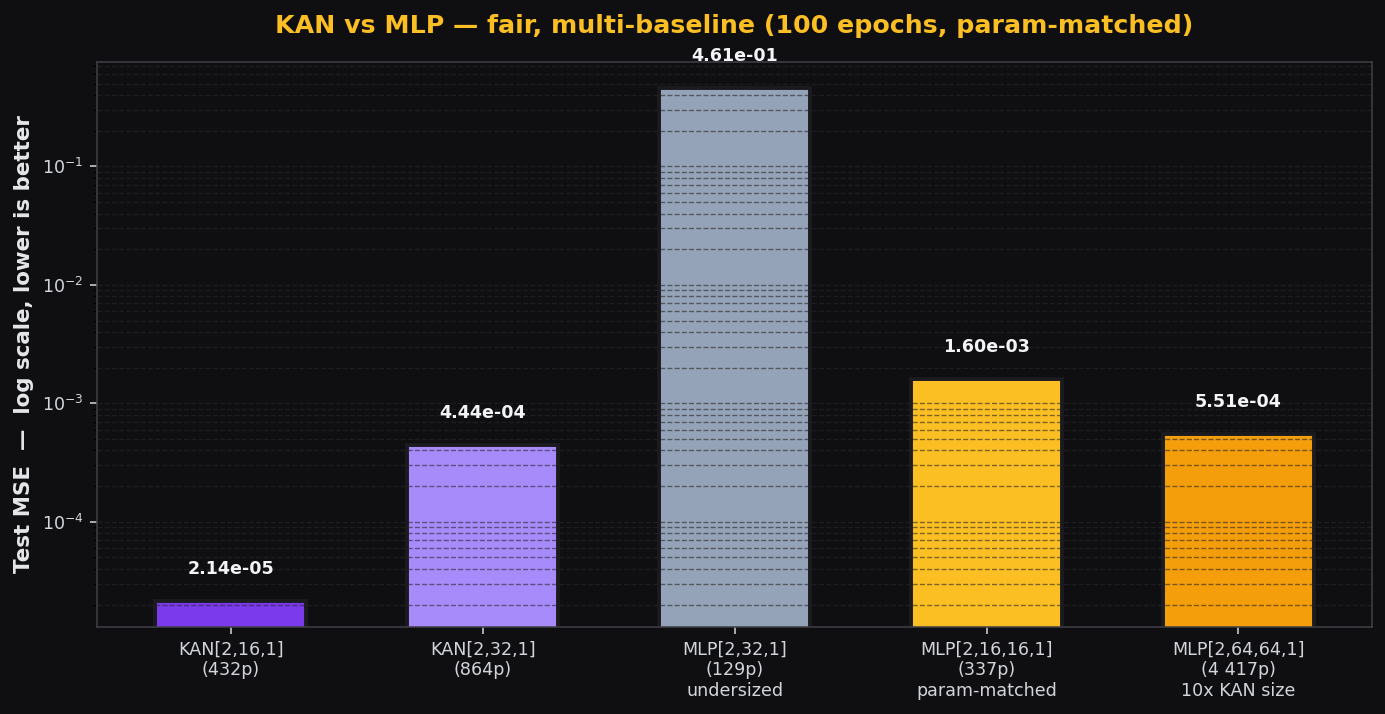
pip install kanx· A small KAN beats a 10× larger MLP on smooth, separable targets — honest, param-matched benchmark below. One library. Two backends. Real ONNX export. Docker + Kubernetes ready. Prometheus metrics, TensorBoard logging, Hub and symbolic extras are now implemented.
⚡ The 30-second magic moment#
import kanx

# Build, train, predict — in one call. No config files. No compile dance.
model = kanx.quickstart()                       # trains on synthetic 2-D data
model.predict([[0.5, 0.2]])                     # → array([[1.04…]])
⚠️ Grid calibration — two methods
KANs use B-splines on a fixed input range (default
[-1, 1]). If your inputs fall outside that range, the spline path silently returns zero and you only get the SiLU residual. Fix it one of two ways:Static approach (pre-training):
from kanx import KAN, fit_grid_to_data
model = KAN([n_features, 64, 1])
fit_grid_to_data(model, X_train)              # one-time grid fit
model.fit(X_train, y_train, epochs=30)
Adaptive approach (during training — recommended):
model = KAN([n_features, 64, 1])
model.fit(X_train, y_train, epochs=15)
model.update_grid_from_samples(X_train)       # ← refine grid based on data
model.fit(X_train, y_train, epochs=15)        # continue training
kanx.check_input_range(model, X)will log a warning at inference if input exceeds the grid.
Want more control? Same simplicity, your data:
from kanx import KAN
import numpy as np

X = np.random.uniform(-1, 1, (1024, 2)).astype("float32")
y = np.sin(np.pi * X[:, :1]) + X[:, 1:2] ** 2

model = KAN([2, 64, 1])
model.fit(X, y, epochs=30, verbose=0)           # auto-compiles with Adam+MSE
model.predict(X[:3])
🔥 PyTorch? Same API.#
from kanx.torch import KAN
import torch

model = KAN([2, 64, 1])
X = torch.randn(1024, 2); y = torch.sin(torch.pi * X[:, :1])
model.fit(X, y, epochs=30, lr=1e-2)             # one-liner, same semantics
model.predict([[0.5, 0.2]])
⚡ GPU-optimized MatrixKAN#
For higher throughput on accelerators, use the vectorized MatrixKAN (replaces recursion with batched GEMM):
from kanx.torch import MatrixKAN

model = MatrixKAN([4, 32, 1])  # same interface as KAN
model.fit(X, y, epochs=30)      # ~1.5–2× faster on GPU vs standard KAN
📦 Installation#
pip install kanx                # core (TensorFlow)
pip install "kanx[torch]"       # +PyTorch backend
pip install "kanx[onnx]"        # +tf2onnx + onnxruntime
pip install "kanx[api]"         # +FastAPI service
pip install "kanx[hub]"         # +HuggingFace Hub integration
pip install "kanx[symbolic]"    # +Symbolic regression hooks
pip install "kanx[all]"         # everything (api + torch + onnx + hub + symbolic + dev + docs)
Optional extras:
* kanx[api] adds FastAPI serving with /metrics Prometheus scraping.
* kanx[torch] adds the PyTorch backend, MatrixKAN, and symbolic helpers.
* kanx[hub] adds push_to_hub() / from_pretrained() for HuggingFace integration.
* kanx[symbolic] adds SymbolicFitter for post-hoc edge function extraction.
→ Open in Colab: Train a KAN in 2 minutes
📊 Benchmarks (reproducible, fair, multi-baseline)#
Synthetic 2-D regression target y = sin(π·x₁) + cos(2π·x₂),
100 epochs, Adam(lr=1e-2), batch=128, CPU.
| Model | Params | Train (s) | Infer 4k (ms) | Test MSE |
|---|---|---|---|---|
| KAN[2,16,1] | 432 | 12.50 | 68.64 | 2.14 × 10⁻⁵ |
| KAN[2,32,1] | 864 | 16.62 | 25.52 | 4.44 × 10⁻⁴ |
| MLP[2,32,1] | 129 | 5.07 | 6.17 | 4.61 × 10⁻¹ (undersized) |
| MLP[2,16,16,1] | 337 | 5.46 | 4.08 | 1.60 × 10⁻³ |
| MLP[2,64,64,1] | 4 417 | 6.00 | 5.74 | 5.51 × 10⁻⁴ |
Honest read. The smallest KAN (432 params) wins on this smooth separable target. The same KAN is ~10–15× slower at inference than a same-MSE MLP because each edge does a B-spline evaluation. On non-smooth or high-dimensional targets, this picture often reverses. We do not claim KANs are universally better than MLPs.
Reproduce with python benchmarks/compare_mlp.py (quick, 100 epochs) or
python benchmarks/compare_mlp.py --long (1000 epochs + early-stopping).
🧠 How kanx compares to other KAN libraries#
| pykan | efficient-kan | mlx-kan | kanx | |
|---|---|---|---|---|
| Framework | PyTorch | PyTorch | MLX (Apple Silicon) | TF + PyTorch |
| Vectorized B-spline | partial | ✅ | ✅ | ✅ |
| ONNX export | ❌ | ❌ | ❌ | ✅ both backends |
| REST API service | ❌ | ❌ | ❌ | ✅ FastAPI |
| Docker + K8s | ❌ | ❌ | ❌ | ✅ |
| Property-based tests | ❌ | ❌ | ❌ | ✅ Hypothesis |
| Test coverage | research | research | research | 94% |
| PyPI | ✅ | ✅ | ✅ | ✅ |
| CI/CD release pipeline | ❌ | ❌ | ❌ | ✅ PyPI + GHCR + Pages |
kanx is the only KAN library purpose-built for production deployment.
Research-y libs are great for novel experiments; kanx is what you ship.
🌐 REST API#
| Method | Path | Purpose |
|---|---|---|
GET |
/api/health |
Liveness + model load source |
GET |
/api/info |
Version + TF/Torch + model summary |
GET |
/metrics |
Prometheus scrape endpoint |
POST |
/api/predict |
Inference (single or batch) |
POST |
/api/load |
Hot-swap checkpoint |
POST |
/api/reset |
Re-init from KANX_CONFIG |
curl -X POST http://localhost:8000/api/predict \
     -H 'content-type: application/json' \
     -d '{"x": [[0.1, -0.2], [0.5, 0.7]]}'
The startup contract loads KANX_CHECKPOINT if it exists, otherwise falls
back to a fresh model built from KANX_CONFIG. Boundaries are validated:
wrong feature count → 400, oversized batch → 413, missing checkpoint → 404.
🔄 ONNX export#
# From PyTorch
from kanx.torch import KAN, export_onnx
model = KAN([2, 64, 1])
export_onnx(model, "kan.onnx")
# From TensorFlow
from kanx import KAN, export_onnx_tf
import tensorflow as tf
model = KAN([2, 64, 1]); model(tf.zeros((1, 2)))
export_onnx_tf(model, "kan.onnx")
✔ Dynamic batch ✔ Verified numerical consistency (1e-5) ✔ Works with ONNX Runtime / TensorRT / OpenVINO
🐳 Docker / ☸️ Kubernetes#
docker run --rm -p 8000:8000 ghcr.io/mattral/kanx:latest
kubectl apply -f k8s/    # Deployment + Service + Ingress + HPA + PVC
K8s manifests ship with rolling updates, readiness/liveness probes on
/api/health, an HPA (2 ↔ 10 replicas, CPU-target 70%) and a PVC for the
model registry.
🛠️ CLI#
python -m kanx info                                          # versions
python -m kanx train --config configs/default.yaml           # train
python -m kanx predict --checkpoint model.keras --input X.json
📚 Documentation#
→ https://mattral.github.io/KANX/ (MkDocs Material)
| Page | What's inside |
|---|---|
| Quickstart | Train your first KAN in 60 seconds |
| Architecture | Package layout, module contracts |
| System Design | Serving topology, scaling, failure modes |
| REST API | Endpoint reference + curl examples |
| Testing | Test pyramid, numerical invariants |
| Deployment | CI/CD, rollout, observability |
| Benchmarks | KAN vs MLP — methodology + numbers |
📄 Research Paper#
If you use kanx in academic work, please cite both the original paper and the library. Our work is formally documented and available as a preprint:
- 📘 Title: Bridging Theory and Practice with KANX
- 📍 DOI: https://doi.org/10.5281/zenodo.20430883
- 📂 Zenodo: https://zenodo.org/records/20430883
- 📄 Read Paper (preprint)
Citation#
@article{mattral2026kanx,
  title={Bridging Theory and Practice with KANX},
  author={Myet, Min Htet},
  year={2026},
  doi={10.5281/zenodo.20430883},
  publisher={Zenodo}
}

@article{liu2024kan,
  title   = {KAN: Kolmogorov-Arnold Networks},
  author  = {Liu, Ziming and Wang, Yixuan and Vaidya, Sachin and Ruehle,
             Fabian and Halverson, James and Soljačić, Marin and
             Hou, Thomas Y. and Tegmark, Max},
  journal = {arXiv preprint arXiv:2404.19756},
  year    = {2024}
}
References#
- Liu et al., KAN: Kolmogorov-Arnold Networks — arXiv:2404.19756
- The Kolmogorov-Arnold representation theorem (Wikipedia)
- B-splines & de Boor algorithm — Carl de Boor (1972)
🤝 Contributing#
PRs welcome! See CONTRIBUTING.md. Good places to start:
- 🔖 Good first issues
- 🗺️
roadmap.md— P0 / P1 / P2 backlog - 💬 Discussions
📜 License#
Apache 2.0. Use it. Ship it. Tell us when you do — we'd love to hear how kanx is being used in the wild.
⭐ Star the repo if kanx saved you time!